Transitioning into a new role can be a source of anxiety and hesitation for newly licensed nurses. The medical-surgical setting presents challenges due to the variety of diagnoses and patient populations encountered. Onboarding serves as an experiential learning opportunity that can either foster or impede the development of novice nurses. A structured orientation and onboarding process is essential in mitigating anxiety and providing support to nurses as they embark on their careers.
How Is Orientation Different From Onboarding?
Orientation and onboarding are distinct processes that are sometimes used interchangeably. Both play important roles in providing new employees with the necessary resources to perform their duties effectively. Employers should aim to make their orientation and onboarding processes both informative and engaging.
Orientation welcomes new staff by introducing them to the facility, working environment, and organizational culture. It covers regulatory programs, policies, mission, and values, fostering a sense of belonging and encouragement. Essentially, orientations formally introduce employees to the facility, setting the stage for their roles.
Onboarding is systematic and structured, detailing milestones and pathways for their new role. It includes position-specific training, seminars, and check-ins lasting months or more than a year. By the end of onboarding, staff should comfortably transition and independently manage their responsibilities.
Key Elements of an Effective Orientation and Onboarding Process
Well-designed onboarding plan
A structured orientation and onboarding plan is crucial for new staff success. The plan includes weekly milestones and clinical pathways to set expectations. Onboarding varies by department and job-specific training needs. ANCC's Practice Transition Accreditation Program sets the global standard for residency or fellowship programs, using evidence-based criteria to ensure excellent nurse transition to new practice settings (ANCC, 2025). Nursing Foundation academies and new grad forums further enhance experiential learning. These activities will help new hires adjust both cognitively and socially. While each person has unique needs, a standardized approach will streamline the onboarding process.
Shared Accountability
A goal is a decision agreed upon by two parties. Once expectations are set between the new hire and the onboarding team, a mutual goal must be established. Goals can vary depending on the nurse. The team must prioritize to determine the greatest benefit for the new licensed nurse. Resources and learning supplements will help the registered nurse become a safe, independent practitioner. Joint accountability fosters teamwork, clear communication, uniform direction, and alignment of goals. It involves a dialogue between the onboarding team and the new hire. Team members share the responsibility for a task's success or failure, including its consequences. The new nurse should complete orientation on time and adapt to changes. Establishing milestones and a clinical pathway will set expectations. Shared accountability also strengthens leadership, agility, and initiatives for everyone on the team.
Intentional Support
The onboarding team includes educators, training associates, hiring managers, unit preceptors, and colleagues in the unit. They must work together for the new hire's success. Each member provides learning and resources to help achieve clinical milestones. The preceptor is vital for learning workflows, processes, communication, and documentation. Nurse preceptors need proper training and workshops on mentoring. Matching the preceptor with the new staff's learning style maximizes learning potential. Scheduling ensures continuity of mentoring and patient care. Using a "Just Culture" approach turns mistakes into learning opportunities. The “Just Culture” approach in nursing emphasizes shared accountability, fostering a culture of safety by recognizing and addressing both system and process deficiencies. The team also tracks progress, celebrates success, and recognizes hard work. Providing support with intent yields several advantages, including fostering a sense of belonging, reducing feelings of isolation, enhancing coping mechanisms, and elevating self-esteem and overall well-being. Furthermore, it can contribute to a stronger sense of purpose, improved relationships, and an increased capacity to navigate challenging circumstances.
Closed-loop communication
Orientation and onboarding can be overwhelming for new employees. Effective communication builds trust and a sense of belonging. Regular check-ins every two weeks capture timely events, skills learned, challenges, and opportunities. Frequent check-ins establish connections and common ground. Genuine feedback provides accountability and transparency, discussing strengths, weaknesses, priorities, milestones, and support. Transparent communication and an accepting attitude are key for successful onboarding. Regular check-ins and feedback help new hires feel heard, confident, and supported.
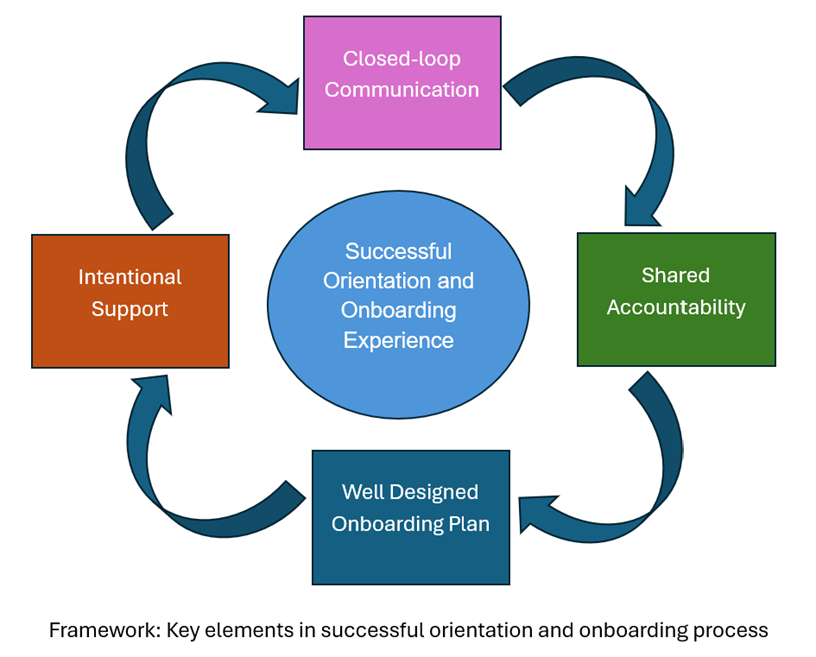
This framework connects crucial aspects for successful orientation and onboarding of new hires, promoting experiential learning. This structural framework is non-linear; each component exhibits dynamism and can interact throughout the orientation and onboarding process. Effective orientation and onboarding depend on all key areas; missing one can led to employee failure and disengagement, disrupting the learning process.
Advantages of Effective Orientation and Onboarding
A successful orientation process is crucial for new hires' long-term success, impacting employee retention, job satisfaction, and turnover rates. BambooHR's survey reveals that 89% of employees reported increased work engagement due to effective onboarding. Moreover, these employees are 30 times more likely to have high job satisfaction compared to those with inadequate onboarding.
Conclusion
Employee onboarding affects an employee's experience within an organization. A new hire requires a multidisciplinary team. Components of an effective onboarding plan include intentional support, shared accountability, and closed-loop communication to improve the learning process. Proper implementation and coordination of the onboarding team can help reduce turnover rates, contributing to workforce longevity and sustainability. Orientation and onboarding are important for a novice nurse transitioning into clinical practice; it can significantly impact their progress, neither making nor breaking them.
References
American Nurses Credentialing Center. (2025). Practice Transition Accreditation Program® (PTAP). Retrieved from https://www.nursingworld.org/organizational-programs/accreditation/ptap/
Pugh, M.-R. (2023, January 24). These 10+ Onboarding Statistics Reveal What New Employees Really Want in 2023. Retrieved from https://www.bamboohr.com/blog/onboarding-
Content published on the Medical-Surgical Monitor represents the views, thoughts, and opinions of the authors and may not necessarily reflect the views, thoughts, and opinions of the Academy of Medical-Surgical Nurses.