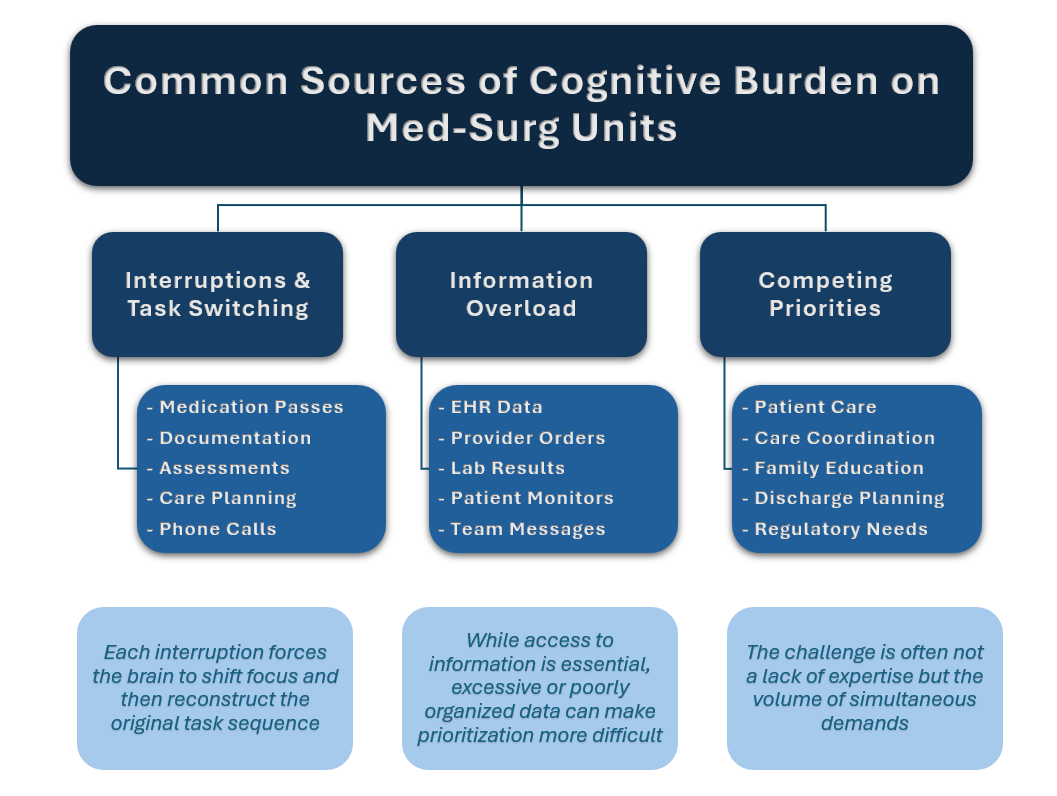
A medical-surgical nurse begins a shift caring for five patients. Within the first two hours, she receives a new admission, coordinates a discharge, responds to multiple interruptions during medication administration, assists a deteriorating patient, and fields questions from family members. While none of these tasks are unusual, together they create a significant cognitive burden that can challenge even the most experienced clinicians.
Today's medical-surgical nurses practice in environments characterized by increasing patient complexity, staffing pressures, and constant information flow. Understanding and addressing cognitive load is becoming an essential component of supporting both patient safety and nurse well-being.
What Is Cognitive Load?
Cognitive load refers to the mental effort required to process information, make decisions, prioritize tasks, and respond to changing clinical conditions. When cognitive demands exceed a nurse's available mental capacity, the risk of errors, missed care, delayed recognition of deterioration, and burnout increases.
The Consequences of Excessive Cognitive Load
Cognitive burden affects both patients and clinicians. Research shows that interruptions and distractions can contribute to medication administration errors.¹ Elevated nursing workload has also been associated with poorer performance, delayed detection of patient deterioration, missed care, adverse events, and burnout.²
Importantly, studies suggest that nurses often develop workarounds to compensate for information gaps, communication inconsistencies, environmental barriers, and competing demands. Rather than expecting nurses to simply work harder, healthcare organizations should examine how systems and processes contribute to cognitive burden.³
Strategies to Reduce Unnecessary Cognitive Load
The goal is not to eliminate cognitive work, which is fundamental to nursing practice. Critical thinking, clinical reasoning, and professional judgment are essential to recognizing patient deterioration, coordinating care, and making informed decisions. Instead, organizations should focus on reducing unnecessary mental demands so nurses can devote their cognitive resources to patient care.
Simplify and Standardize Communication
Communication failures remain a major contributor to errors and inefficiencies in healthcare. Standardized approaches such as SBAR, structured handoffs, interdisciplinary rounds, and daily safety huddles can help reduce the mental effort required to gather and interpret information.
When nurses spend less time searching for information or clarifying messages, they can focus more attention on assessment, prioritization, and clinical decision-making.
Make Information Easy to See and Understand
Healthcare generates enormous amounts of data, but data alone does not improve decision-making. Nurses benefit most when information is presented in a clear, visual, and actionable way.
Research has identified data visualization as an important contributor to situational awareness. Visual management boards, unit dashboards, patient status indicators, color-coded alerts, and concise rounding tools can help nurses quickly identify priorities and potential risks.⁵
The goal is not more information — it is better visibility of the right information at the right time.
Use Smart Technology to Support Clinical Decision-Making
Technology can either increase or decrease cognitive burden depending on its design. When thoughtfully implemented, smart technologies can help reduce manual information gathering and support clinical judgment.
Examples include:
- Clinical decision support tools
- Automated risk stratification
- Predictive analytics
- Smart alerts that prioritize actionable information
- Integrated patient monitoring systems
Research suggests that technology is most effective when it enhances situational awareness and reduces unnecessary mental effort rather than simply generating additional data.
Smart technology should serve as a clinical partner — not another source of distraction.
Reduce Documentation Burden
Documentation is essential, but redundant documentation and poorly designed workflows can consume significant cognitive resources.
Researchers have identified data redundancy, cumbersome data entry requirements, and poor workflow navigation as major contributors to documentation burden. Nurses also report that EHR components that do not align with clinical workflows increase the effort required to document care.⁴
Every duplicate entry, screen change, and unnecessary click represents mental energy that could otherwise be directed toward patient care.
Minimize Interruptions During High-Risk Tasks
Interruptions are among the most common and preventable contributors to cognitive overload.
Organizations can help by:
- Establishing quiet zones for medication preparation
- Reducing nonurgent interruptions
- Clarifying escalation pathways
- Implementing consistent communication expectations
Even modest reductions in interruptions can improve concentration and task completion.¹
Support Situational Awareness Through Team-Based Care
Situational awareness — the ability to perceive, understand, and anticipate clinical events — is a cornerstone of patient safety. It allows nurses to recognize subtle changes in patient condition and respond before complications occur.
Evidence suggests that team communication, experience, data visualization, and reduced fatigue all contribute to stronger situational awareness.⁵ Regular interdisciplinary rounds, shift huddles, and proactive discussions of at-risk patients can help teams anticipate challenges rather than simply react to them.
The safest teams share a common understanding of priorities, risks, and next steps.
Conclusion
Medical-surgical nurses are expected to synthesize complex information, make rapid decisions, and adapt continuously to changing patient needs. While cognitive work is an essential part of nursing practice, unnecessary cognitive burden should not be.
Reducing cognitive load is not about simplifying nursing — it is about creating environments that allow nurses to practice at the top of their expertise. By streamlining communication, improving information visibility, leveraging thoughtfully designed technology, reducing documentation inefficiencies, and supporting team-based situational awareness, healthcare organizations can help nurses focus on what matters most: delivering safe, high-quality, patient-centered care.
As patient complexity continues to grow, addressing cognitive load is no longer simply a workforce initiative — it is a patient safety imperative.
References
1. Thomas L, Donohue-Porter P, Fishbein JS. Impact of Interruptions, Distractions, and Cognitive Load on Procedure Failures and Medication Administration Errors. Journal of Nursing Care Quality. 2017;32(4):309-317. https://psnet.ahrq.gov/issue/impact-interruptions-distractions-and-cognitive-load-procedure-failures-and-medication
2. Yuan Z, Wang J, Feng F, et al. The Levels and Related Factors of Mental Workload Among Nurses: A Systematic Review and Meta-analysis. International Journal of Nursing Practice. 2023. https://onlinelibrary.wiley.com/doi/10.1111/ijn.13148
3. Potter P, Wolf L, Boxerman S, et al. An Analysis of Nurses' Cognitive Work: A New Perspective for Understanding Medical Errors. AHRQ. https://www.ahrq.gov/downloads/pub/advances/vol1/Potter.pdf
4. Cho H, Nguyen OT, Weaver M, et al. Electronic Health Record System Use and Documentation Burden of Acute and Critical Care Nurse Clinicians: A Mixed-Methods Study. Journal of the American Medical Informatics Association. 2024. https://pubmed.ncbi.nlm.nih.gov/39259920/
5. Avalos J, Roy D, Asan O, Zhang Y. The Influential Factors on Nurses' Situation Awareness in Inpatient Settings: A Literature Review. Human Factors in Healthcare. 2021. https://www.sciencedirect.com/science/article/pii/S2772501422000033
Content published on the Medical-Surgical Monitor represents the views, thoughts, and opinions of the authors and may not necessarily reflect the views, thoughts, and opinions of the Academy of Medical-Surgical Nurses.