Picture this.
It's a busy morning on a medical-surgical unit. A patient recovering from a stroke receives breakfast. The tray ticket says, "Level 6 Soft & Bite-Sized with Level 2 Mildly Thick liquids." The nursing assistant brings the tray, the nurse administers medications, and everyone moves on to the next patient.
Seems routine.
But what if the kitchen, speech-language pathologist, pharmacy, and nursing staff each have a slightly different understanding of what "mildly thick" or "soft and bite-sized" means? That small inconsistency could increase the patient's risk of aspiration, choking, malnutrition, dehydration, or aspiration pneumonia (Cichero et al., 2016; Cunningham et al., 2026).
This is exactly why the International Dysphagia Diet Standardisation Initiative (IDDSI) was developed and why every medical-surgical nurse should become familiar with it.
Dysphagia Is More Common Than We Think
Dysphagia affects millions of people worldwide and is particularly common among hospitalized older adults and individuals with stroke, Parkinson's disease, dementia, head and neck cancer, and other neurological conditions (Cunningham et al., 2026; Steele et al., 2014; Vishak & Ramasamy, 2024). Hospitalized patients may also develop swallowing difficulties because of acute illness, prolonged intubation, generalized weakness, or deconditioning (Macht et al., 2013).
Medical-surgical nurses care for these patients every day.
Many patients arrive with swallowing precautions already in place. Others develop dysphagia during hospitalization. Because nurses spend the greatest amount of time with patients during meals and medication administration, they are often the first clinicians to recognize coughing during meals, changes in voice quality, difficulty swallowing medications, or other signs that swallowing may no longer be safe. Early recognition and prompt communication with the healthcare team can reduce the risk of serious complications.
So, What Is the IDDSI?
The IDDSI created a globally standardized framework for texture-modified foods and thickened liquids (Cichero et al., 2016; International Dysphagia Diet Standardisation Initiative [IDDSI], 2026).
Instead of relying on inconsistent terms such as "nectar thick," "honey thick," or "mechanical soft," the IDDSI uses eight standardized levels, ranging from Level 0 (Thin) to Level 7 (Regular), each with clearly defined testing methods that can be used consistently across healthcare settings (IDDSI, 2026).
This standardized language improves communication among nurses, speech-language pathologists, dietitians, pharmacists, food service personnel, patients, and caregivers. When everyone speaks the same language, patients receive safer and more consistent care.
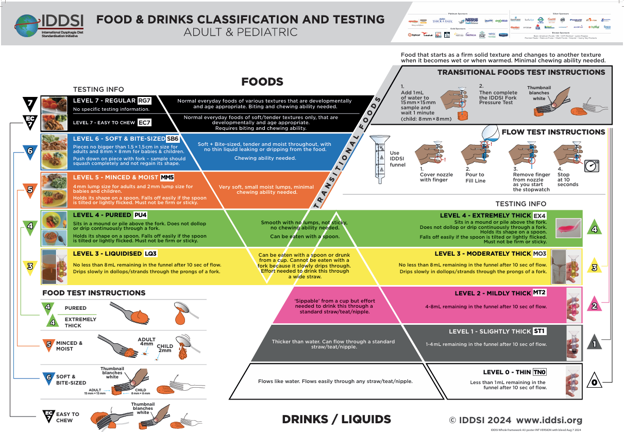
Food & Drinks Classification and Testing: Adult and Pediatric © IDDSI 2024
Why It Matters at the Bedside
For bedside nurses, the IDDSI is much more than another policy. It is a patient safety strategy.
Consider how many times nurses are directly involved in activities related to swallowing during a shift:
- Administering oral medications
- Assisting with meals
- Reinforcing aspiration precautions
- Educating patients and families
- Monitoring hydration and nutrition
- Communicating changes in swallowing status
- Collaborating with speech-language pathology and dietary services
Each interaction presents an opportunity to reduce, or unintentionally increase, a patient's risk of aspiration.
Research has shown that standardized dysphagia terminology and testing methods improve consistency of care and interdisciplinary communication, both of which are essential for preventing adverse events (Cichero et al., 2016; Cunningham et al., 2026; Wu et al., 2022). Understanding the IDDSI helps nurses confidently verify that foods and liquids match prescribed swallowing recommendations and recognize when something does not appear consistent with the patient's prescribed diet.
Medication Administration Matters, Too
Medication administration deserves particular attention.
Patients with dysphagia often require modifications to how medications are administered. However, crushing tablets or mixing medications into foods without assessing medication characteristics may alter drug absorption or effectiveness (Blaszczyk et al., 2023). In addition, medications mixed into foods or liquids should remain compatible with the patient's prescribed IDDSI level (Malouh et al., 2020).
Nurses should collaborate closely with pharmacists and speech-language pathologists before altering medication administration methods. Taking a moment to verify the safest approach can prevent complications while preserving medication efficacy.
Nurses Are the Final Safety Check
Medical-surgical nurses are accustomed to serving as the final safety check before care reaches the patient.
We verify medications.
We confirm patient identity.
We perform bedside assessments.
The same mindset applies to dysphagia management.
If a patient's meal tray appears inconsistent with the prescribed IDDSI level, if liquids appear thinner than expected, or if medications cannot be safely administered according to swallowing recommendations, nurses should feel empowered to pause and clarify before proceeding.
Speaking up protects patients.
Standardization only improves safety when every member of the healthcare team consistently follows the same framework (IDDSI, 2026).
Education Builds Confidence
Although nurses frequently care for patients with dysphagia, studies have demonstrated considerable variability in healthcare professionals' knowledge, experience, preparedness, and adoption of dysphagia management and IDDSI implementation, highlighting the need for ongoing education, practical training, and implementation support (Cunningham et al., 2026).
Fortunately, becoming comfortable with the IDDSI does not require becoming a swallowing specialist. It means understanding a few essential principles:
- Know the IDDSI levels used in your organization.
- Review swallowing precautions before meals.
- Verify food and liquid consistency whenever something seems incorrect.
- Collaborate with speech-language pathology, pharmacy, and nutrition services.
- Educate patients and families using standardized terminology.
- Never hesitate to ask questions when uncertain.
These simple practices strengthen interdisciplinary collaboration while promoting safer patient care.
Every Nurse Has a Role
Implementing the IDDSI is about much more than changing diet labels. It represents a commitment to standardized, patient-centered care.
Medical-surgical nurses play a unique role because they connect multiple disciplines while spending the greatest amount of time with hospitalized patients.
Whether assisting with breakfast, administering medications, monitoring swallowing safety, or preparing patients and caregivers for discharge, nurses have opportunities every day to reduce aspiration risk and improve patient outcomes.
The next time you review a patient's diet order, remember that food texture and liquid thickness are not simply dietary preferences. They are evidence-based safety interventions supported by international standards (IDDSI, 2026).
By embracing the IDDSI, nurses strengthen interdisciplinary communication, improve consistency of care, and help ensure that every patient receives the safest possible nutrition and hydration.
Sometimes the safest intervention is not another medication or procedure.
Sometimes it is making sure the next bite, or the next sip, is the right one.
References
Blaszczyk, A., Brandt, N., Ashley, J., Tuders, N., Doles, H., & Stefanacci, R. G. (2023). Crushed Tablet administration for patients with dysphagia and enteral feeding: Challenges and considerations. Drugs & Aging, 40(10), 895–907. https://doi.org/10.1007/s40266-023-01056-y
Cichero, J. A. Y., Lam, P., Steele, C. M., Hanson, B., Chen, J., Dantas, R. O., Duivestein, J., Kayashita, J., Lecko, C., Murray, J., Pillay, M., Riquelme, L., & Stanschus, S. (2016). Development of international terminology and definitions for texture-modified foods and thickened fluids used in dysphagia management: The IDDSI framework. Dysphagia, 32(2), 293–314. https://doi.org/10.1007/s00455-016-9758-y
Cunningham, R., Jahed, N., Sundman, E., Gustafsson, J. K., & Bergström, L. (2026). Implementing the International Dysphagia Diet Standardisation Initiative: Prospects and pitfalls. Global Implementation Research and Applications. https://doi.org/10.1007/s43477-026-00209-6
International Dysphagia Diet Standardisation Initiative, Inc. (2026). Complete IDDSI framework detailed definitions. https://www.iddsi.org/images/Publications-Resources/DetailedDefnTestMethods/English/V2-2DetailedDefinitionsEnglish30Jul2026pdf.pdf
Macht, M., Wimbish, T., Bodine, C., & Moss, M. (2013). ICU-acquired swallowing disorders. Critical Care Medicine, 41(10), 2396–2405. https://doi.org/10.1097/CCM.0b013e31829caf33
Malouh, M. A., Cichero, J. A., Manrique, Y. J., Crino, L., Lau, E. T. L., Nissen, L. M., & Steadman, K. J. (2020). Are medication swallowing lubricants suitable for use in dysphagia? Consistency, viscosity, texture, and application of the International Dysphagia Diet Standardization Initiative (IDDSI) framework. Pharmaceutics, 12(10), 924. https://doi.org/10.3390/pharmaceutics12100924
Steele, C. M., Alsanei, W. A., Ayanikalath, S., Barbon, C. E. A., Chen, J., Cichero, J. A. Y., Coutts, K., Dantas, R. O., Duivestein, J., Giosa, L., Hanson, B., Lam, P., Lecko, C., Leigh, C., Nagy, A., Namasivayam, A. M., Nascimento, W. V., Odendaal, I., Smith, C. H., & Wang, H. (2014). The influence of food texture and liquid consistency modification on swallowing Physiology and Function: A systematic review. Dysphagia, 30(1), 2–26. https://doi.org/10.1007/s00455-014-9578-x
Vishak, M. S., & Ramasamy, K. (2024). Swallowing rehabilitation: Tracing the evolution of assessment and intervention approaches for dysphagia over 30 years. Indian Journal of Otolaryngology and Head and Neck Surgery: Official Publication of the Association of Otolaryngologists of India, 76(2), 2171–2175. https://doi.org/10.1007/s12070-023-04325-9
Wu, X. S., Miles, A., & Braakhuis, A. (2022). The Effectiveness of International Dysphagia Diet Standardization Initiative-Tailored Interventions on Staff Knowledge and Texture-Modified Diet Compliance in Aged Care Facilities: A Pre-Post Study. Current Developments in Nutrition, 6(4), nzac032. https://doi.org/10.1093/cdn/nzac032
Content published on the Medical-Surgical Monitor represents the views, thoughts, and opinions of the authors and may not necessarily reflect the views, thoughts, and opinions of the Academy of Medical-Surgical Nurses.